
Insights
7 Signs Your Business Website Needs a Redesign

If you’re wondering whether your business needs a new website, the signs are usually staring you in the face — you’re just not sure what to look for. This guide covers the clearest signs you need a new website, what each one is costing you in real terms, and what to do about it. Whether you’re based in Staffordshire, the West Midlands, or anywhere in the UK, these indicators apply to any business that relies on its website to attract customers.
Why Your Website Matters More Than Ever
For most businesses, the website is the first thing a potential customer sees before making contact. Not the shop front, not the business card — the website. A poor website sends people to your competitor before they’ve even read your contact number. A well-built site, on the other hand, works around the clock generating enquiries, building trust, and converting visitors into paying customers.
Starting out, most business owners do the right thing: they get a basic website up quickly, just to have something on the internet. Maybe it was a DIY builder like Wix or Squarespace, or a budget package from a local agency. It served a purpose at the time. But as the business grows — as you win bigger contracts, take on more staff, or expand your services — that starter site starts holding you back.
Sign 1: Your Website Looks Outdated
Design trends move fast. A site that looked modern in 2018 now reads as dated — and your visitors notice instantly, even if they can’t articulate why. First impressions on the web take just 0.05 seconds to form. If your site looks old, visitors assume your business is old, slow, or not investing in quality.
Specific signs of an outdated design include: stock photos that look like clip art, text in narrow columns with large blank margins, a non-responsive layout that looks cramped on mobile, or a colour scheme straight from 2010. If your website embarrasses you when you hand someone your business card, that is a strong signal it is time for a redesign.
For businesses in Staffordshire and the West Midlands — where clients increasingly check you out online before picking up the phone — looking professional digitally is just as important as a tidy office or branded van.
Sign 2: It Does Not Work Properly on Mobile
Well over half of web traffic now comes from mobile devices. If your website is not built to work on a smartphone screen — meaning text is too small to read, buttons are too close together to tap accurately, and users have to pinch and zoom to navigate — you are losing more than half your potential enquiries before they start.
Google also uses mobile-first indexing, which means it judges your site quality based on the mobile version, not the desktop version. A poor mobile experience does not just frustrate users — it actively damages your Google rankings and makes it harder for local customers to find you in search results.
Test this right now: pull up your website on your own smartphone. Can you read the text without zooming? Can you tap the phone number to call? Can you find what you are looking for within 10 seconds? If the answer to any of those is no, mobile is likely your biggest leak.
Sign 3: It Is Not Generating Enquiries
This is the big one. A website that is not bringing in leads is not doing its job, no matter how nice it looks. If you are getting traffic but not enquiries, the problem usually lies in one of three places: the calls to action are not clear enough, the trust signals (reviews, case studies, testimonials) are missing or buried, or the copy does not speak directly to what your customer actually wants.
A business website should make it blindingly obvious what you do, who you do it for, and what the visitor should do next. Every page should have a clear next step — whether that is calling you, filling in a form, or downloading a resource. If visitors land on your site and are not sure what action to take, most of them will leave without taking any.
Common culprits include: a contact form buried in the footer, a phone number that is not clickable on mobile, no evidence of your work or results, and copy that talks about you instead of the customer problem. A well-structured website redesign addresses all of these by focusing on conversion as the primary goal.
Sign 4: You Have Outgrown What the Site Can Do
Many businesses reach a point where they want to do things the website simply cannot support: add an e-commerce function, integrate a booking system, accept online payments, add a client portal, or present a new service range properly. If you find yourself working around your website — directing people to ring up instead of book online, manually chasing leads that could be automated, or avoiding adding new services because it is too complicated to update the site — the underlying platform is the problem.
A modern WordPress website built with scalability in mind gives you the flexibility to grow without starting from scratch every time your business evolves. Adding services, updating prices, publishing new case studies, or integrating third-party tools should all be straightforward — not a major project.
Sign 5: It Is Slow to Load
Page speed is one of the most overlooked problems on older websites. Google research has found that more than half of mobile visitors leave a page that takes longer than 3 seconds to load. Every extra second of load time reduces conversions. A slow site not only frustrates visitors — it is also penalised by Google in rankings.
Common causes of slow loading include: unoptimised images, bloated themes or plugins, poor hosting, and outdated code. You can test your site speed for free at Google PageSpeed Insights. If you are scoring below 70 on mobile, speed is actively costing you customers.
Sign 6: You Cannot Update It Yourself
If adding a new team member photo, updating your service pricing, or publishing a blog post requires emailing your web developer and waiting days for a change, that is a problem. Your website should be something you control. Content that goes stale — old staff photos, outdated pricing, services you no longer offer — actively erodes trust with visitors and signals to Google that the site is not being maintained.
A properly built WordPress website with a clean admin interface means any member of your team can make content updates in minutes, without coding knowledge. If your current setup does not allow this, it is a sign the site was built for the developer convenience, not yours.
Sign 7: Your Competitors Sites Look Better Than Yours
This one matters. When a potential customer is weighing you up against two competitors, the one with the most professional, trustworthy-looking website often wins the enquiry — even if you are actually the better business. Perception shapes decisions, especially for higher-value purchases like professional services, construction, or consultancy.
Search for the top 3 competitors in your area. If their sites look significantly more modern, easier to navigate, or more conversion-focused than yours, you are losing business to them purely on presentation. That is fixable.
What a Website Redesign Actually Involves
A professional website redesign is not just a coat of paint — it is a strategic rebuild focused on getting results. At Spires Web Tech, our process covers:
- Discovery: Understanding your business, your customers, and what a successful website needs to achieve
- Strategy: Deciding on structure, content, and the conversion journey for each type of visitor
- Design: Creating a professional, on-brand design that works on all screen sizes
- Build: Developing the site in WordPress for ease of management and scalability
- Content: Writing copy that speaks to your customers and ranks in Google searches
- SEO: On-page optimisation, speed tuning, and technical configuration from day one
- Launch and aftercare: Ongoing support, hosting, maintenance, and updates as your business grows
If you are a business in Staffordshire — whether you are in Lichfield, Burntwood, Cannock, or Tamworth — we have been building and rebuilding local business websites since 2011. We know what works for Staffordshire audiences and we have the track record to prove it.
Frequently Asked Questions
How much does a website redesign cost?
Most small business website redesigns with Spires Web Tech start from around £1,200 to £2,500 depending on the size and complexity of the site. We also offer managed website packages from £99/month that include design, build, hosting, and ongoing updates — so there is no large upfront cost. Every project starts with a free consultation where we will give you an honest, no-obligation quote.
How long does a website redesign take?
For most small business websites, we work to a 4 to 8 week timeline from kickoff to launch. The exact timeframe depends on the number of pages, the complexity of any custom functionality, and how quickly we can gather content and feedback from you. We keep you updated throughout the process.
Will a redesign affect my existing Google rankings?
Done correctly, a redesign should improve your rankings, not harm them. We preserve your existing URL structure wherever possible, implement proper redirects for any pages that change, and apply on-page SEO from the outset. Many of our clients see improved rankings within 3 to 6 months of launching a redesigned site.
Can I keep my existing content?
Yes — we can migrate your existing text, images, and blog posts into the new design. We will also review your content and advise on what to update, expand, or remove to improve both the user experience and your search rankings.
What if I just want to update my existing site, not start fresh?
In some cases, smaller updates — refreshing the design, improving the navigation, or adding new pages — can be done without a full rebuild. We will be honest with you about which approach makes more sense for your situation. If your underlying platform and structure are sound, a refresh may be the better investment.
Ready to See What Is Possible?
If you have spotted more than one of the signs above in your current website, it is worth having a conversation. We offer a free website audit and consultation — no obligation, no sales pressure. We will tell you honestly what is working, what is not, and what a better website could do for your business.
Book your free consultation today and let us see how much more your website could be doing for you.
Get a free website audit worth £197, or book a free call with Mark.
Keep reading
More from Insights
Our new website: what is new at Spires Web Tech
Spires Web Tech has a fresh new website: published prices, real case studies, local pages and a free website audit.
Read the article →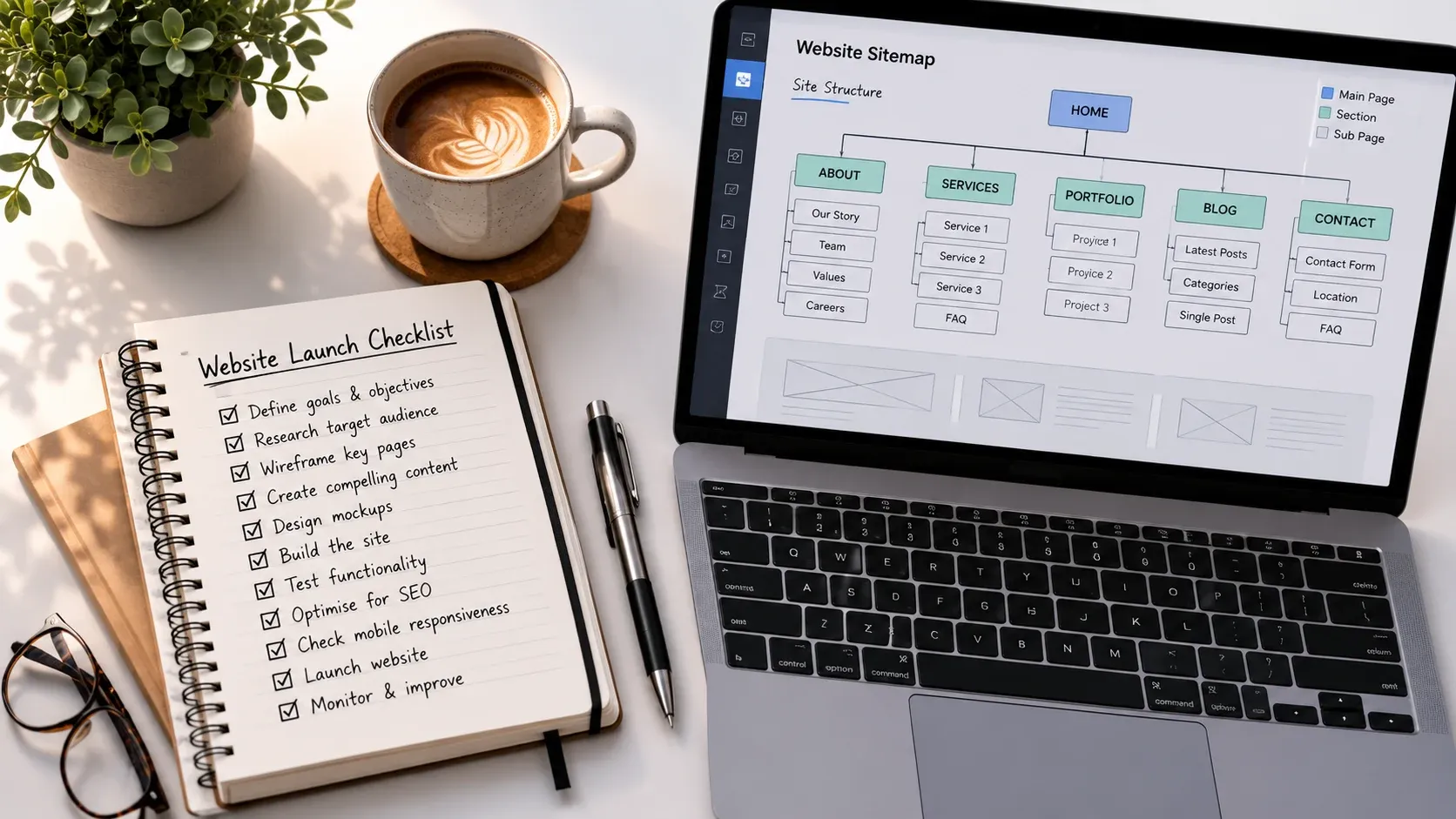
New Website Checklist: Your Complete Planning Guide for 2026
Most website projects don't fail at the build stage. They fail at the planning stage - or rather, because there wasn't one.
Read the article →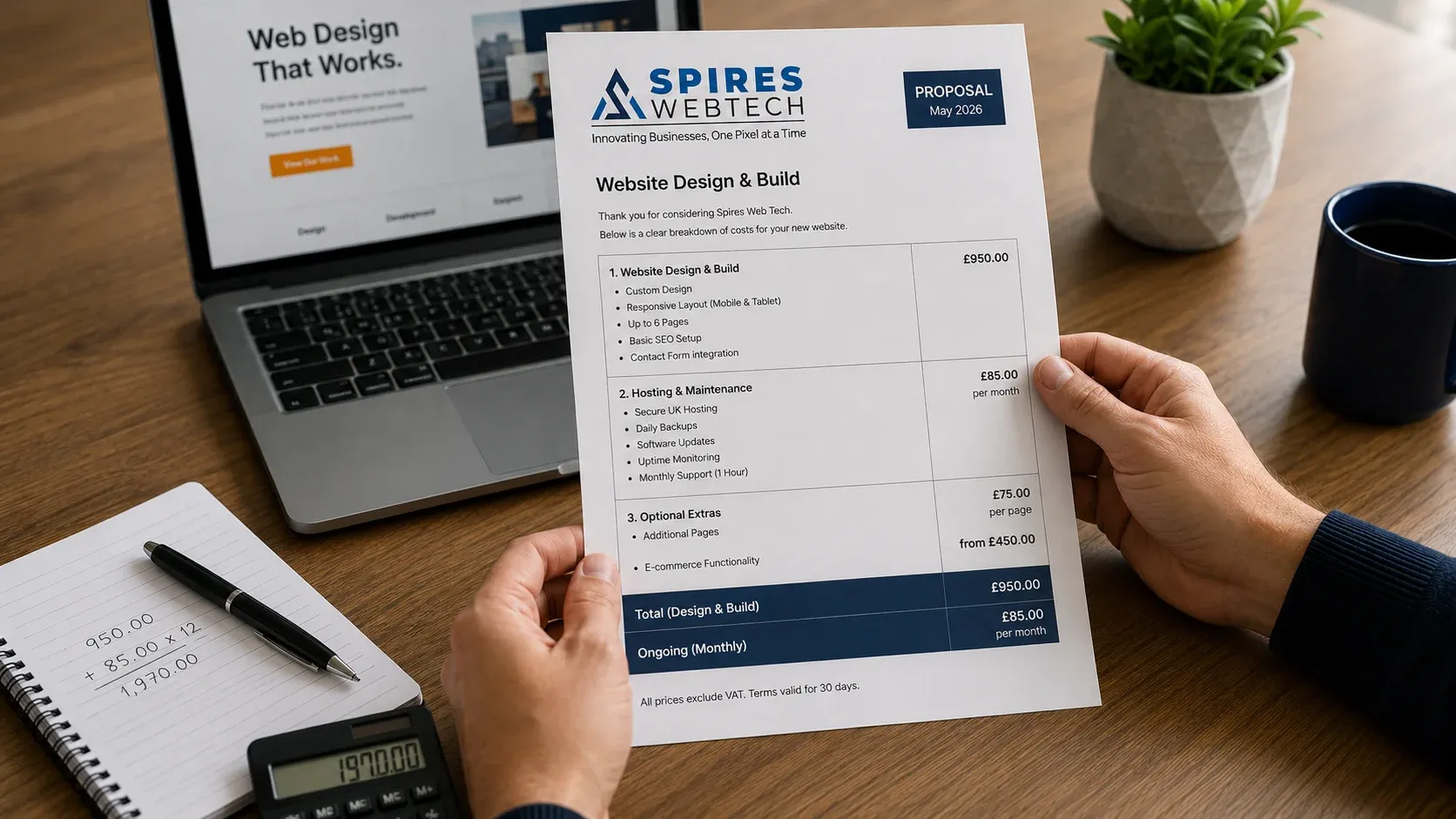
How Much Does a Website Cost in the UK in 2026?
If you've ever typed "how much does a website cost" into Google, you'll know the answers vary wildly -- from £99 templates to £50,000…
Read the article →